SEO in Mauritius: the complete 2026 guide for local businesses
How Google Mauritius works, why search volumes are small, English vs French searches, local rankings and a step-by-step plan to rank your Mauritian business.
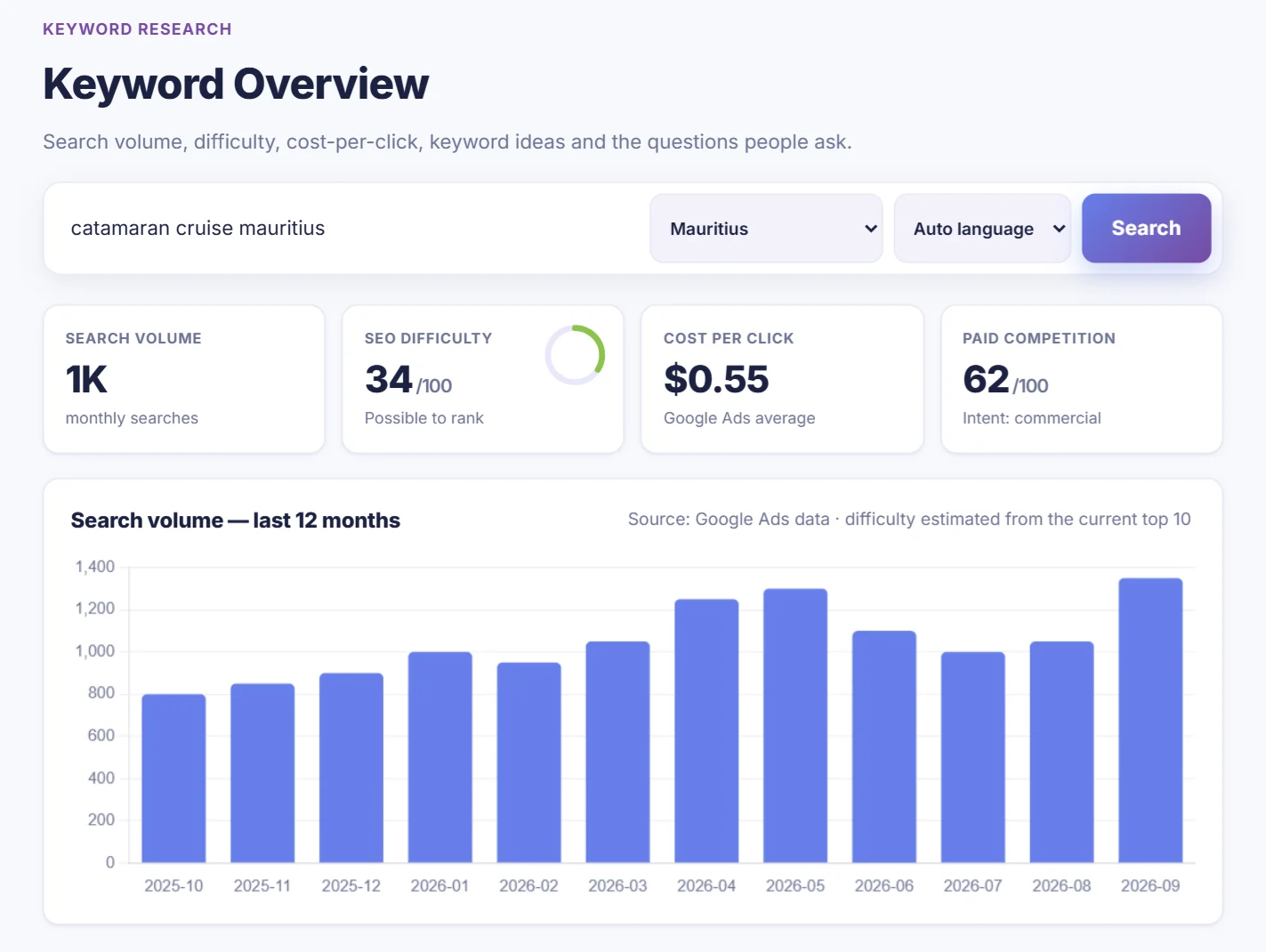
- Google handles about 90% of searches in Mauritius and just over half of traffic is on mobile.
- Decide first whether your customers search from Mauritius or from abroad: it changes your competitors and keywords.
- Small search volumes are normal: judge keywords by the value of one customer, not by volume.
SEO advice is written mostly for big markets like the US, the UK or France. Mauritius is different: a small population, searches in two or three languages, and many customers who aren't even on the island when they search. This guide explains how Google works in Mauritius and gives you a 90-day plan to rank your business.
How Mauritians search
According to DataReportal's Digital 2026 report, Mauritius has about 1.01 million internet users, 79.5% of a population of 1.27 million. Google handles about 90% of searches and Bing most of the rest (StatCounter). Just over half of web traffic is on mobile (StatCounter), so your site must work perfectly on a phone, but desktop still matters for business, banking and property searches.
In practice: optimise for Google, check Bing Webmaster Tools once, and test every important page on your phone.
Why the numbers look tiny (and why that's fine)
Open most SEO tools, type a Mauritian keyword and you'll see "0" or "no data". That's not because nobody searches, it's because the market is small and many tools don't collect data for it. Search volumes for Mauritius do exist in Google Ads data: CrazyDodo uses it, which is why you see real numbers where other tools show blanks.
Three things to keep in mind:
- Small numbers are normal. 50 searches a month for "accounting firm quatre bornes" can mean several new clients a year. Judge keywords by the value of one customer, not by volume.
- The long tail matters more. Specific searches (service + town, product + brand, questions) add up to more than the few big keywords.
- Seasons are strong. Tourism searches peak before European winter holidays; school, wedding and property searches have their own seasons. Use the 12-month chart in Keyword Overview.
Locals or visitors: choose your market
This is the most important decision in Mauritian SEO. A Mauritian searching "restaurant grand baie" from Curepipe sees Google Mauritius. A French tourist planning a holiday searches from Paris and sees Google France. Same business, completely different competitors.
- Mostly local customers (shops, clinics, accountants, schools): track Google Mauritius.
- Mostly visitors (hotels, villas, tours, weddings): track the countries your guests come from, such as France, the UK, South Africa or India, or International for a worldwide English audience.
- Both: track Mauritius plus your main source market. CrazyDodo Pro projects can follow up to 3 markets at once.
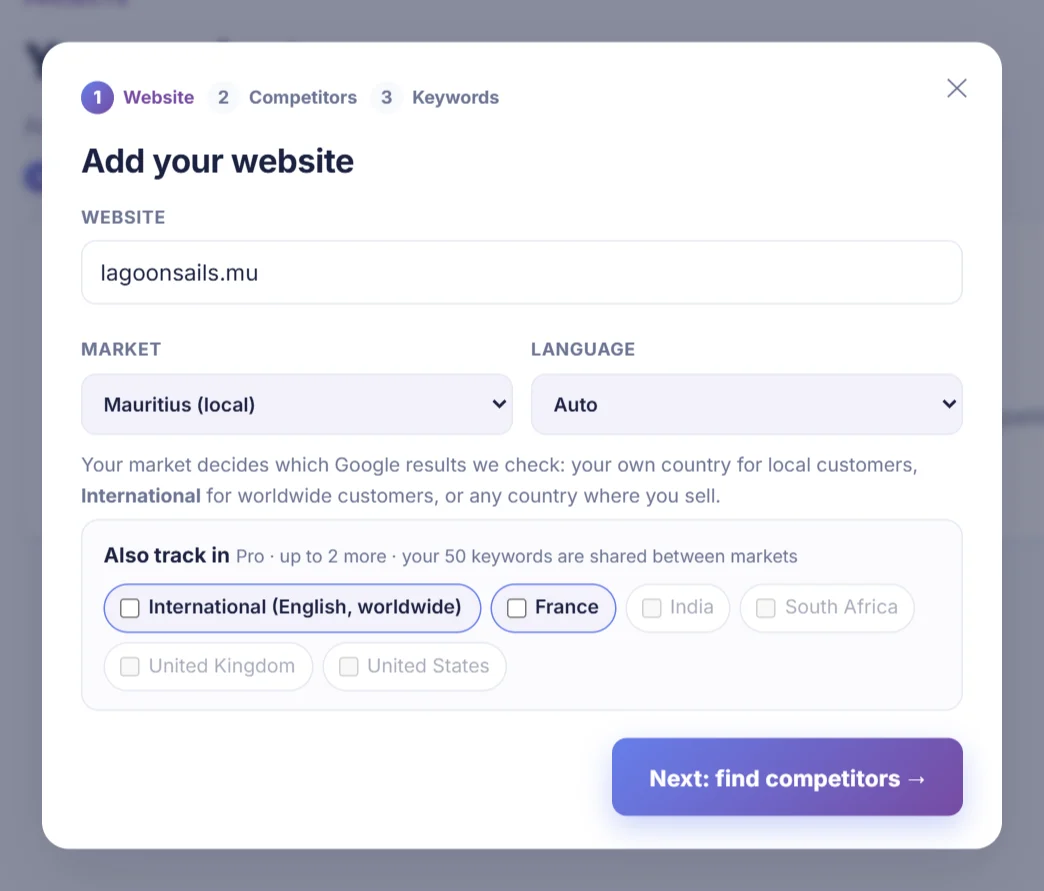
Search your main keyword on google.mu in a private window, then ask a friend abroad to do the same. If the results are different, you need to decide which market matters more to you.
English, French or both?
Most Mauritian websites are in English, with a large share also in French (BuiltWith). Kreol is the language most people speak at home, but in our experience searches for businesses and services are typed mostly in English or French. Practical rules:
- Write in the language your customers search in, not the language you speak at the office. French visitors search in French; many locals search in English for business services and in French for some products.
- If you have both, make separate pages per language (not both languages mixed on one page) and link them with hreflang tags. Only 26% of the sites in our study use hreflang.
- Check keyword volumes in both languages: villa à louer île maurice and villa rental mauritius are different searches with different competitors.
Local SEO in Mauritius
- Google Business Profile: claim it, choose the right category, add your opening hours, photos and the area you serve. It drives the map results for "near me" searches.
- Name, address, phone: write them exactly the same way on your website, your profile, Facebook and directories.
- Town names: people search by town or region (Grand Baie, Quatre Bornes, Ebène, Flic en Flac, the north). Mention the areas you serve naturally on your pages, and create a page per location only if you really have one.
- Reviews: ask every happy customer. Reply to all reviews, good and bad.
- .mu domain: a .mu address tells visitors and search engines you're Mauritian, which helps for local searches. If you target visitors from abroad, a .com is fine too.
Get the basics right
Our study of 70 Mauritian websites that rank on Google found the same problems again and again: 77% have images without alt text, 47% have titles that are too long or too short, 30% have no H1 heading and 21% have no meta description. These are quick fixes.
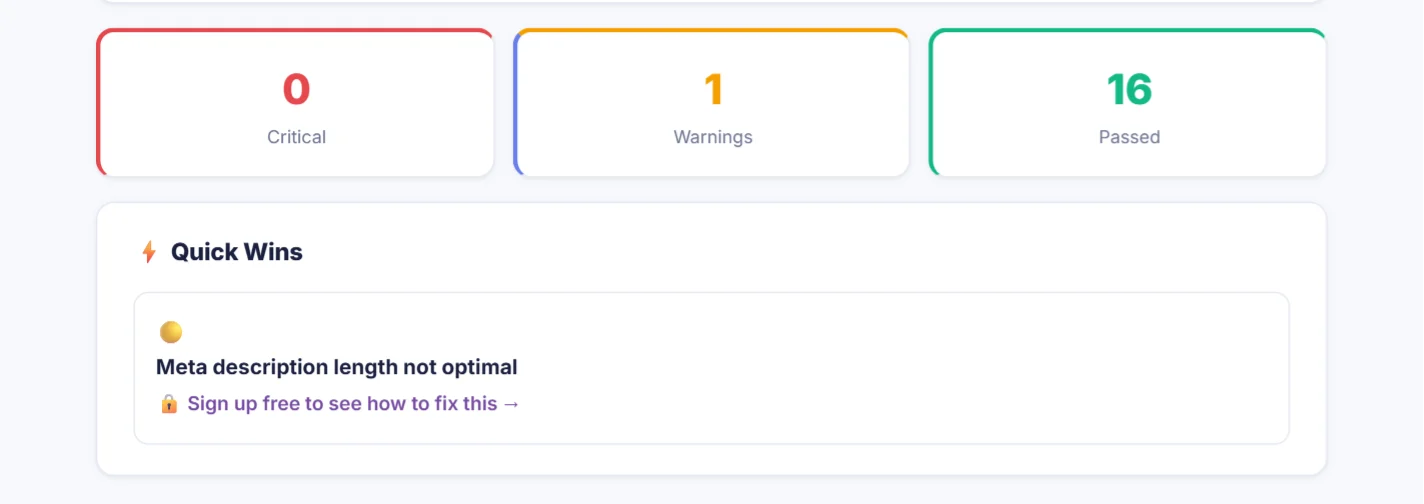
Run the free CrazyDodo analysis on your home page, then a site audit to check every page.
The AI search opportunity
More and more people ask ChatGPT, Gemini or Google's AI Overviews for recommendations: "best catamaran trip in Mauritius", "good dentist in Quatre Bornes". These assistants quote websites that answer clearly and describe themselves with structured data. In our study, 96% of Mauritian sites had no FAQ markup and 90% had no question-style headings. Very few local businesses are doing this yet, so a few hours of work now can put you ahead of your competitors:
- Add an FAQ with the real questions customers ask, and mark it up as FAQPage.
- State facts plainly: prices or price ranges, opening hours, locations, what's included.
- Add Organization or LocalBusiness structured data.
- Check your GEO and AEO scores in the free analyzer.
Earning links in Mauritius
Links from other websites still matter, and in a small country a few good local links go a long way:
- Your suppliers, partners and clients (a "partners" or "where to buy" page).
- Business associations and chambers you belong to, such as the MCCI or your sector association.
- Local media and blogs: share real news, data or expert comments, not press releases about nothing.
- Events and sponsorships with a page about them.
Use the Traffic Analyzer to see which sites link to your competitors.
Set it up step by step
Here is how to turn this guide into action with free tools, from your first check to tracking your rankings on Google Mauritius.
- 1
Check where you stand
Run a free analysis of your home page. Note your SEO and AI-readiness scores and the critical issues.
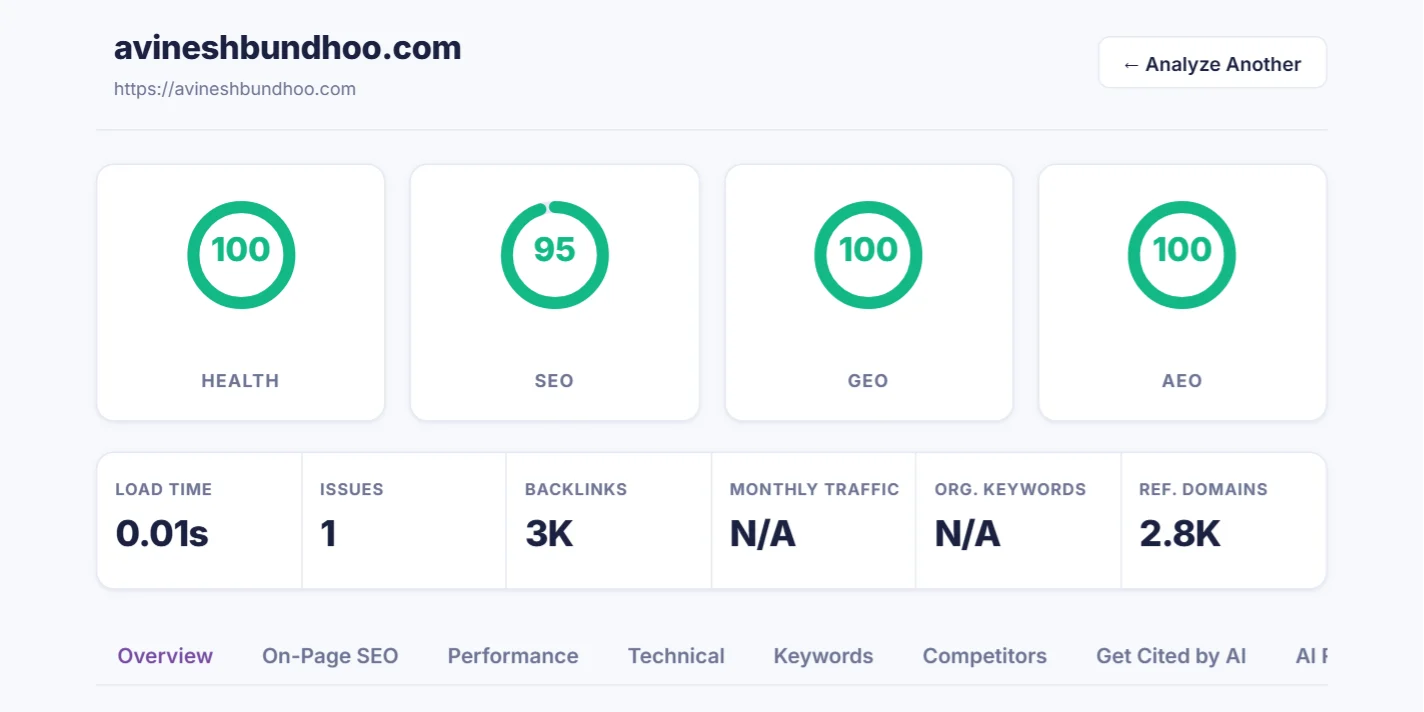
Your starting point: four scores out of 100. - 2
Look up what people search in Mauritius
In Keyword Overview, choose Mauritius and type the main search for your business. You see monthly searches, difficulty and the seasonal trend.
Monthly searches in Mauritius, from Google Ads data (demo data). - 3
Find the longer, easier searches
Open Keyword Ideas. Look for searches with a town, a service or a question, and a green difficulty score. Check the same in French.
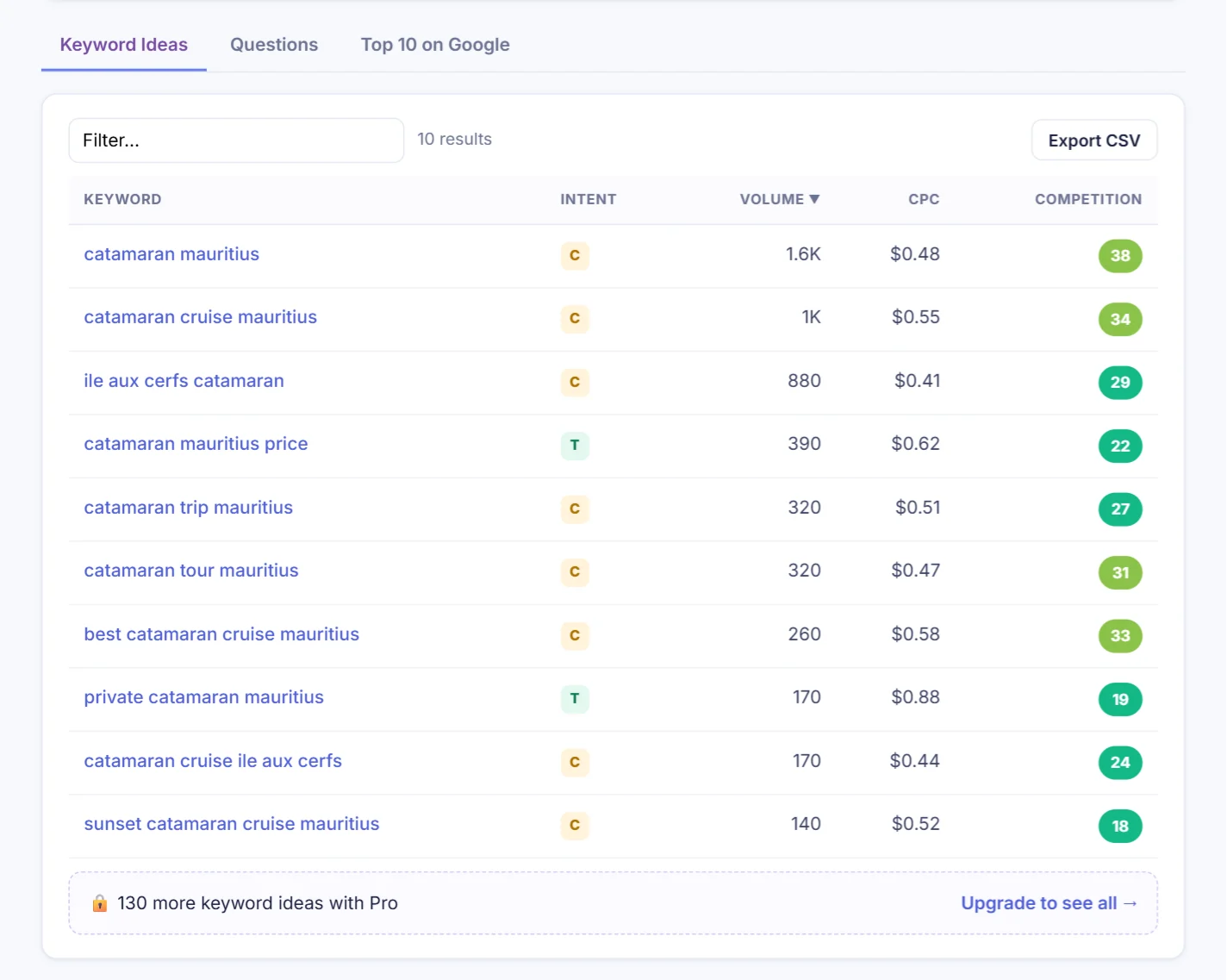
Related searches with volume and difficulty (demo data). - 4
See who ranks today
The Top 10 tab shows the websites on page one of Google Mauritius for that search. These are your real competitors online, not always the ones you think.
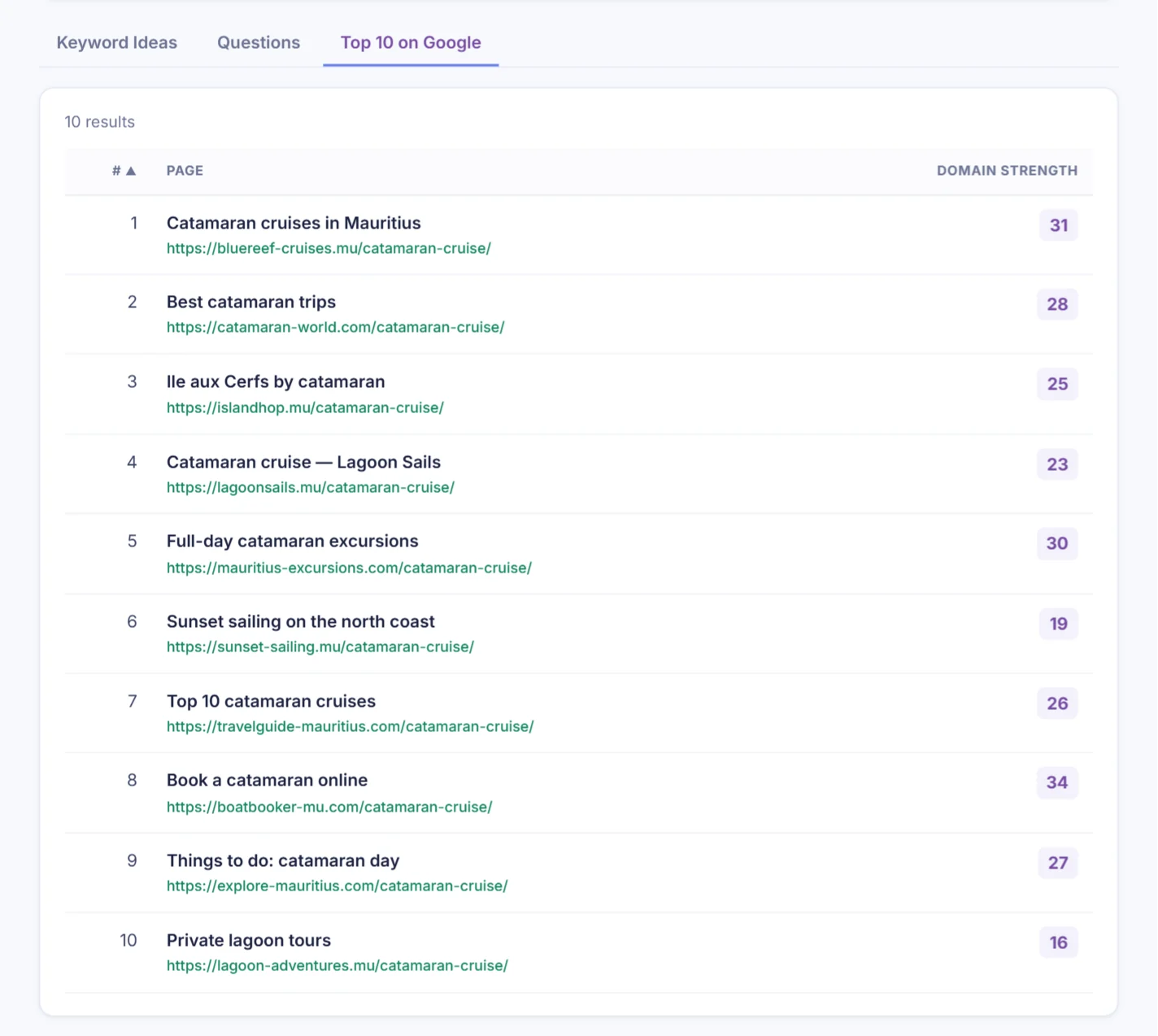
The live top 10 for a search (demo data). - 5
Create a project for your market
Create a free account and a project. Choose Mauritius, or the country your customers search from. On Pro you can add up to two more markets.
Step 1 of the project: your website and market. - 6
Track your rankings every week
Pick 3 to 5 competitors and up to 10 keywords. CrazyDodo checks them every week (daily on Pro) and shows your position next to each competitor.
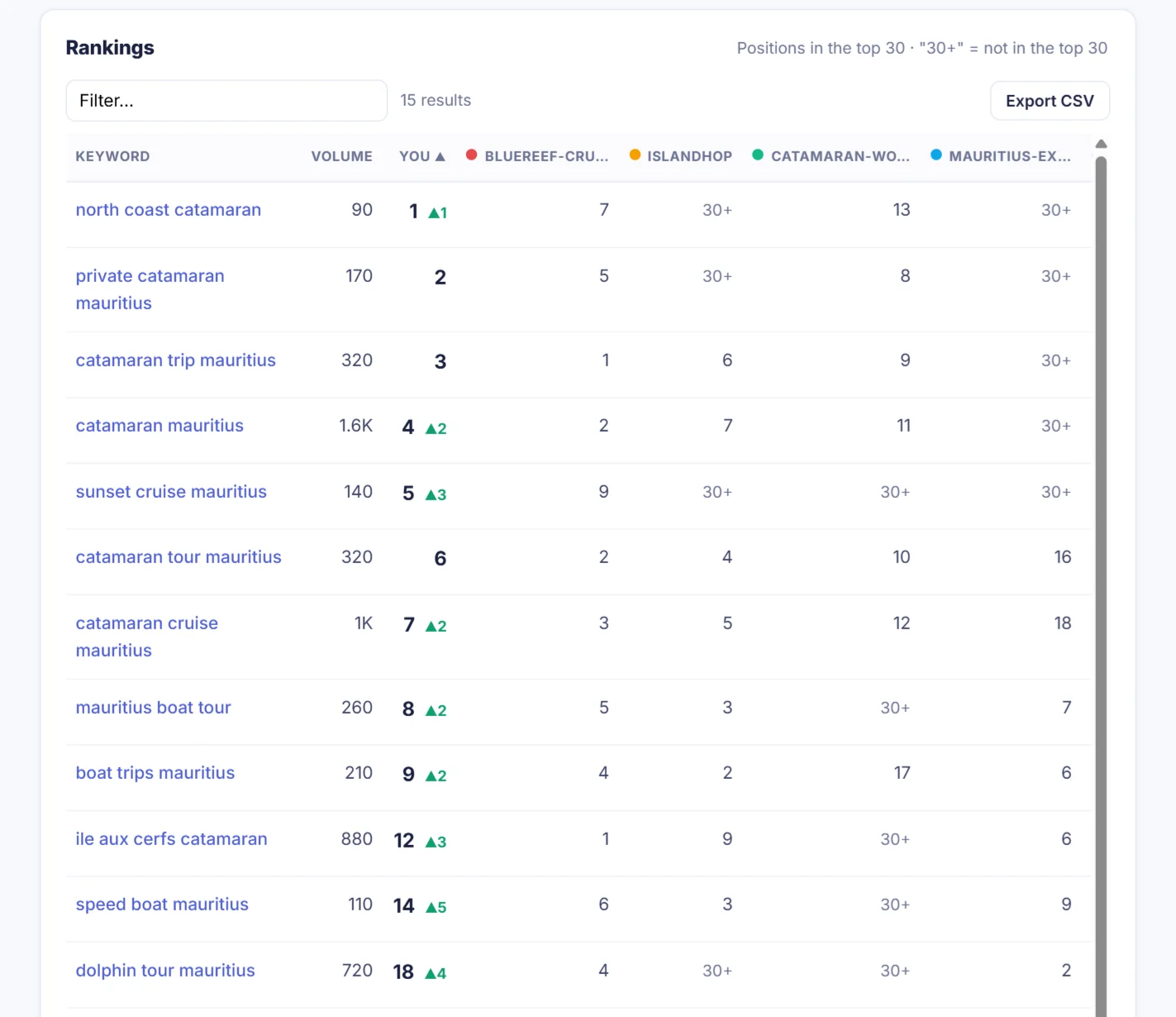
Your position for each keyword, with a column per competitor (demo data).
A 90-day plan
| When | What to do |
|---|---|
| Week 1 | Set up Google Search Console and your Google Business Profile. Run a free analysis and a site audit. |
| Weeks 2–3 | Fix titles, descriptions, H1s and image alt text on your 10 most important pages. |
| Week 4 | Create a project: choose your market(s), 3–5 competitors and your 10–50 keywords. |
| Month 2 | Improve the pages ranking 4–15. Add an FAQ section and structured data. Publish one useful article a week answering customer questions. |
| Month 3 | Ask for reviews and 5 local links. Re-run the audit, compare rankings with month 1 and keep going with what moved. |
See your SEO and AI-readiness scores in about a minute.